
Oasis Artesian BTSA1SHS
$511.72 at Amazon
Check it on AmazonPrice as of Nov 16, 2026, 5:34 AM EST
Details ↓Three bottled hot-and-cold coolers, sorted by how many cups an hour they pour and what their warranties allow in a business.

As an Amazon Associate I earn from qualifying purchases.
For a waiting room, get the Oasis Artesian BTSA1SHS. ENERGY STAR lists 0.90 gallons of cold water an hour, about 29 four-ounce cups, the highest figure of any cooler we checked, and Oasis covers the refrigeration system for 3 years. If nobody should lift a 42 lb bottle onto the top, get the bottom-loading Brio 520 or Primo Deluxe 601090.
All three were new and the buy-box offer at our 12:01 AM check on Oct 22. Output and energy figures come from ENERGY STAR; the rest from each maker’s manual or spec sheet.

Product prices and availability are accurate as of the date/time indicated and are subject to change. Any price and availability information displayed on Amazon.com at the time of purchase will apply to the purchase of this product.
ENERGY STAR measures cold output in gallons an hour. In a waiting room, cups are the number that matters.
A gallon is 128 ounces, so it fills 32 four-ounce paper cones. At 0.90 gallons an hour, the Oasis Artesian can chill about 29 of them an hour. The Brio 520 and the Primo 601090 land at about 24 and 23.
That’s the rate the cooler refills its cold tank, not the most it can pour at once.
The tank holds a reserve for a rush. Brio’s manual lists a 3.6-liter cold tank on the 520, about 121 ounces, or 30 four-ounce cups ready before the compressor has to catch up.
So a cooler handles a short line well. A steady stream all afternoon is where the hourly figure starts to show.
Prices and availability are accurate as of the time shown and may change.
Visitors arrive all day, someone on staff can lift a full bottle, and you want the longest warranty on the part that costs most to fix.
Bottles get changed by whoever is free. The bottom-loading Brio 520 takes the lifting out.
The Artesian is Oasis International’s bottled water cooler for break rooms, here in the Hot ’N Cold version, model BTSA1SHS, with stainless side panels and a black front. It was new and in stock at our 12:01 AM check on Oct 22, sold by Megamart USA. Oasis also makes a Cook ’N Cold version, BTSA1SK, that pours room-temperature water in place of hot.
It leads this page on cold water. ENERGY STAR lists 0.90 gallons an hour, about 29 four-ounce cups, against 0.74 for the Brio 520. Oasis’s own spec sheet shows how much the room matters: 1.4 gallons an hour in a 70°F room, falling to 0.5 at 100°F.
Hot water comes from a one-piece stainless tank with a 500-watt element and a 1½-quart store. Oasis rates it at 45 six-ounce cups an hour, enough for tea and instant oatmeal at a steady pace. The hot faucet closes itself and takes a two-step action, which Oasis says is easy for adults and protects small children.
Three details suit a waiting room. The cabinet comes with pre-drilled holes for a cup dispenser. Oasis’s WaterGuard system is built to stop spills during bottle changes and keep dust out of the reservoir. The drip tray lifts out and goes in the dishwasher.
The warranty is the longest here. Oasis gives 3 years on the sealed refrigeration system and 1 year on most other parts, within the continental U.S. and Canada. The Oasis owner’s warranty we read promises repair to the original purchaser and sets no home-only limit.
Inside, a hermetically sealed 1/20 hp compressor cools a stainless reservoir wrapped in foam, and the cold thermostat adjusts from the back. Oasis says the parts that touch water are lead-free under the Safe Drinking Water Act and certified to NSF/ANSI 372.
The trade-off is the bottle. It’s a top loader, so someone lifts a full 5-gallon bottle, about 42 lb of water, onto a cooler 38⅛ in. tall and turns it over. It weighs about 37 lb, measures 12 × 12½ in. at the base and runs on 115 volts.
Our call: for a waiting room with steady traffic and a staff member who can lift bottles, this is the cooler to buy.
Prices and availability are accurate as of the time shown and may change.
Anyone on staff might change the bottle, and you want hot, cold and room-temperature taps with a built-in UV cycle.
The cooler has to sit close to a wall. The Primo 601090 needs 4 in. behind it, not 8.
The 520 is Brio’s bottom-loading cooler with UV self-cleaning, model CLBL520SC in stainless. The black version is CLBL520SCBLK. Both were new at our 12:01 AM check on Oct 22, sold by Amazon.com, and the black one had 11 left.
Bottom loading is the reason to buy it. The bottle slides into the lower cabinet and a probe draws water up, so nobody lifts 42 lb over their head. It takes 3- or 5-gallon bottles, and a red light flashes when the bottle runs empty.
Brio’s manual lists cold water at 37 to 50°F from a 3.6-liter tank and hot water at 176 to 198°F from a 1-liter tank, with a flow of 1.5 liters a minute. ENERGY STAR puts its cold output at 0.74 gallons an hour, about 24 four-ounce cups, and its hot output at 46 six-ounce cups.
The UV light runs on its own schedule: 40 minutes on, 140 minutes off, around the clock while the cooler is plugged in. Brio says the UV-LED lamp must be repaired by the manufacturer only. It doesn’t replace the reservoir cleaning the manual asks for every 3 to 4 months.
Hot water takes two steps. You release the child lock, then press, and the button relocks after each pour. An LED nightlight lights the taps, which helps in a dim lobby after hours.
Plan the spot before it arrives. The back must sit at least 8 in. from the wall, twice the Primo’s clearance. It stands 41.4 in. tall, 12.2 in. wide and 15.6 in. deep, and Brio says it runs in rooms from 39°F to 104°F.
Brio’s warranty covers all parts for 1 year for the original buyer and sets no home-only limit. It disclaims products bought from sellers that aren’t authorized retailers, so check the seller and keep the receipt.
ENERGY STAR lists the 520 in one family with Brio’s CLBL420V2, which shares its cold, hot and energy figures but has no UV light. Our call: the bottom-loading pick for an office where anyone might change the bottle.
Prices and availability are accurate as of the time shown and may change.
You want a bottom loader that can sit 4 in. from the wall and a cleaning cycle staff can start on the way out.
The room fills up for long stretches. The Oasis Artesian chills about 6 more cups an hour.
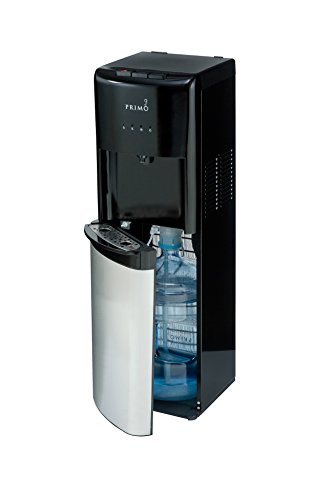
The Deluxe 601090 is Primo’s stainless bottom-loading cooler, with one spout and three push buttons for hot, cool and cold. It was new and in stock at our 12:01 AM check on Oct 22, sold by Solutions by Staples.
Its self-cleaning works differently from Brio’s. Once a week you hold a switch on the back for 5 seconds. Ozone goes into the tanks and water lines to kill bacteria and biofilm, and by the end of the cycle it has turned back into oxygen.
The cycle takes 90 minutes, and Primo says not to drink from the cooler while it runs, because the water may taste odd. Primo suggests running it overnight or when staff are away from the office, which suits a waiting room that closes at night.
ENERGY STAR lists 0.72 gallons of cold water an hour, about 23 four-ounce cups, the least of our three picks. Hot output is 46 six-ounce cups an hour, the same as the Brio, and it draws 0.76 kWh a day with both tanks on.
The hot button has a child safety feature: slide the red button away from you, then press. Lights show power, cooling, heating and the cleaning cycle, and a red light blinks when the bottle is empty. An LED nightlight behind the bottle support has its own switch.
It takes 3-, 4- or 5-gallon bottles and needs 4 in. of space behind and on both sides. Primo’s manual says to use its purified bottled water to keep mineral deposits out of the lines.
Primo’s warranty covers all parts for 1 year for the original buyer, with no home-only limit. Like Brio’s, it disclaims products bought from sellers that aren’t authorized retailers and may ask for proof of purchase, so keep the invoice.
One caution on model numbers: Primo’s hTrio dispensers, 601225, 601229 and 601240, were recalled in 2018 and sit in the same ENERGY STAR family as this cooler. The 601090 isn’t one of them. Our call: the bottom loader for an office that can run a cleaning cycle after closing.
From ENERGY STAR and the makers’ manuals and spec sheets. Scroll sideways on a phone.
| Pick | Spec score | Loading | Cold, gal/h | Cold 4-oz cups/h | Hot 6-oz cups/h | kWh/day | Warranty | Wall gap | Sold by | Buy |
|---|---|---|---|---|---|---|---|---|---|---|
| Oasis Artesian BTSA1SHS | 8.4 | Top | 0.90 | 29 | 45 | 0.66 | 3 yr refrigeration, 1 yr parts | Not stated | Megamart USA | Check it on Amazon |
| Brio 520 CLBL520SC | 8.3 | Bottom | 0.74 | 24 | 46 | 0.76 | 1 yr | 8 in. | Amazon.com | Check it on Amazon |
| Primo Deluxe 601090 | 8.2 | Bottom | 0.72 | 23 | 46 | 0.76 | 1 yr | 4 in. | Solutions by Staples | Check it on Amazon |
All three are ENERGY STAR “high capacity” coolers, the class EPA says suits busy spaces like an office. None of the three warranties limits use to a home.
Same seven checks as the picks. We only pick a cooler that scores 7.0 or more.
| Cooler | Spec score | What held it back | What it does well |
|---|---|---|---|
| Frigidaire EFWC498 | 5.9 | Warranty void outside single-family household use; 0.54 gal/h cold; top load | 11 in. wide; 0.67 kWh a day; child lock on the hot tap |
| Avalon A4 | 6.2 | Not on the ENERGY STAR list despite the listing’s claim; no output figures published | Warranty covers commercial use by name; bottom load |
The Frigidaire is built for a home kitchen. Its manual, from Curtis International, says the 1-year warranty is void if it’s used for anything other than single-family household use. A waiting room isn’t that.
The Avalon A4 is the opposite case: good warranty terms, missing numbers.
Home-size coolers are a different kind of product, so we didn’t score them against these. Brio’s 130 series, for one, is ENERGY STAR “low capacity”: 8 hot cups an hour against 46 on the Brio 520.
For a home kitchen, those smaller units make sense. For a lobby, they run out of hot water fast.
A cooler can only chill water as fast as it sheds heat into the room around it.
Oasis is the only maker here that prints output against room temperature. In a 70°F room the Artesian chills 1.4 gallons of water to 50°F an hour. At 90°F it manages 0.6, less than half.
Other compressor coolers follow the same physics, even when the maker doesn’t print the chart.
Give it air. Brio wants 8 in. behind the 520 and free airflow on every side, and Primo wants 4 in. behind and on both sides. Brio also says to keep it out of direct sun.
A cooler wedged into a sunny corner next to a radiator pours fewer cold cups than its rating.
The question nobody’s store page answers. We read each warranty for the words that matter in an office.
| Cooler | Term | Business use | Other conditions | Source |
|---|---|---|---|---|
| Oasis Artesian | 3 yr sealed refrigeration; 1 yr most parts | No home-only limit | U.S. and Canada; certificate in the box | Oasis spec sheet and owner’s warranty |
| Brio 520 | 1 yr all parts | No home-only limit | Original buyer; authorized sellers only | Brio CLBL520SC manual |
| Primo 601090 | 1 yr all parts | No home-only limit | Original buyer; proof of purchase from an authorized seller | Primo 601090 manual |
| Frigidaire EFWC498 (not picked) | 1 yr | Void outside single-family household use | Original consumer; receipt needed | Frigidaire EFWC498 manual |
| Avalon A4 (not picked) | 1 yr | Covers commercial use by name | Register within 30 days | Avalon warranty page |
Two warranties disclaim coolers bought from sellers that aren’t authorized retailers: Brio’s and Primo’s. Neither lists those retailers in the manual, so if the seller’s name on Amazon isn’t familiar, ask the maker before you buy.
Keep the invoice either way. Both may ask for proof of purchase.
A cooler draws power all day to hold its hot and cold tanks ready, even when nobody’s drinking.
The spread is small. The Oasis uses 0.66 kWh a day, the Brio and Primo 0.76, a difference of about 36 kWh a year. Multiply by your own electric rate from your bill to see the dollars.
For most offices, the energy gap between these three won’t decide anything.
The bigger lever is the hot tank. Brio’s manual says to turn off the heating and cooling switches if the cooler sits unused for more than 24 hours, and to drain it.
A waiting room closed for a long weekend can switch off the hot side on Friday.
Recall note: in March 2018, Primo recalled about 11,000 hTrio beverage dispensers (models 601225, 601229 and 601240, bought on or before Dec 31, 2017) because hot water can drip when used above 6,000 ft. CPSC lists a free replacement. None of our picks is recalled; our CPSC search for Oasis, Brio, Primo, Frigidaire and Avalon coolers found nothing else for these models.
A worked example: one 4-oz cup per visitor, five days a week. Change the visitor count to match your room.
| Visitors a day | 4-oz cups a week | 5-gal bottles a week | Weeks per 5,000-cup case |
|---|---|---|---|
| 20 | 100 | 0.6 | 50 |
| 50 | 250 | 1.6 | 20 |
| 100 | 500 | 3.1 | 10 |
| 200 | 1,000 | 6.3 | 5 |
The arithmetic: a 5-gallon bottle holds 640 ounces, which is 160 four-ounce cups. A 3-gallon bottle holds 96. A 5,000-cup case of Solo cones is about 31 bottles’ worth of cups.
For a rush, add the tank to the hourly rate. On the Brio 520 that’s about 30 cold cups waiting plus 24 an hour, so more than about 54 in one hour outruns it.
Water weight is the other planning number. The U.S. Geological Survey puts a gallon of water at about 8.34 lb, so a full 5-gallon bottle carries about 42 lb of water before the bottle itself.
Store spares on the floor, close to the cooler, so nobody carries them far.
A waiting room needs cups beside the tap. These were new and in stock at our 12:01 AM check on Oct 22; check the cup size against the dispenser.


Product prices and availability are accurate as of the date/time indicated and are subject to change. Any price and availability information displayed on Amazon.com at the time of purchase will apply to the purchase of this product.
| Dispenser | Cups it holds | Mounting | Works with the Solo 4 oz cones? | Source |
|---|---|---|---|---|
| San Jamar C3165WH | 4–10 oz flat or cone, rims 2.5–3.25 in. | Wall or water cooler | Yes, 4 oz is in range | San Jamar listing |
| San Jamar C4150SS | 3–4.5 oz cone, 3–5 oz flat, rims 2.25–2.875 in. | Top-loading, gravity fed | Yes, 4 oz is in range | San Jamar listing |
| Avalon A1CUPDISP | 4–10 oz; not wide coffee cups | Side of an Avalon cooler with its bracket, or a wall | Yes, 4 oz is in range | Avalon listing |
Solo’s own listing makes the case for cones in a waiting room. With no flat bottom, a cone can’t be set down on a table and forgotten, so fewer half-full cups end up on the chairs.
Solo says these are designed for cold water, so offer a different cup for tea.
Where the dispenser goes depends on the cooler. Oasis pre-drills the Artesian’s cabinet for a cup dispenser but its sheet doesn’t name a model. Avalon’s bracket is made for Avalon coolers.
On the Brio or Primo, mount a San Jamar on the wall beside the cooler.
It’s the biggest day-to-day difference between our picks.
| Top load (Oasis Artesian) | Bottom load (Brio 520, Primo 601090) | |
|---|---|---|
| Changing the bottle | Lift about 42 lb of water to the top and flip it | Slide it into the cabinet; a probe draws water up |
| Seeing the water level | The bottle is in plain view | An empty-bottle light tells you |
| Spills at changeover | WaterGuard is built to stop them | No flip, so no splash |
| Cold output (EPA) | 0.90 gal/h | 0.72–0.74 gal/h |
| Warranty | 3 yr refrigeration | 1 yr |
If one strong person always handles deliveries, the Oasis’s extra output and longer warranty win. If the front desk changes bottles between patients, bottom loading prevents the lift that strains backs and floods carpets.
Bottom loaders also hide the bottle, which looks tidier in a lobby.
All three picks run on bottles. Here’s when a different kind of dispenser fits better.
| Type | Water comes from | Install | Where to read more |
|---|---|---|---|
| Bottled cooler | 3- or 5-gallon bottles | Plug in; no plumber | The three picks above |
| Bottleless (point-of-use) cooler | A cold water line, through a filter | Needs a water line run to it | Water services such as Culligan and FloWater, which ranked for “office water cooler” when we searched |
| Plumbed bottle filler or drinking fountain | The building’s water line | A plumber installs it on the wall | Our sister site PlumbingPicks covers bottle-filler filters |
A bottled cooler is the only one of the three you can set up the day it arrives. Bottleless coolers trade bottle deliveries for a water line and a filter schedule, which is why Google’s top results for office coolers are full of rental and delivery services.
If your landlord won’t allow a new water line, bottled is the answer.
From the makers’ setup and safety pages.
8 in. for the Brio 520; 4 in. behind and at the sides for the Primo.
Oasis lists 115 volts with a three-wire cord and polarized plug.
The Brio and Primo nightlights help in a dim corner or after hours.
Brio says to keep the cooler in a dry, cool place, out of direct sunshine.
Brio warns that paper or foam under the cooler can hold water.
Primo says never to let children pour hot water without direct supervision.
Put it where staff can see it from the desk. A hot tap within reach of a toddler is the main risk in a family waiting room, and every pick’s lock takes two steps for that reason.
A hard floor or a drip mat under the cooler catches the splashes paper cups bring.
Brio’s manual gives the clearest routine. Follow your own model’s manual where it differs.
Wipe the cabinet, controls, bottle probe and spout with a clean cloth and a food-grade sanitizer or bleach.
Empty and clean the drip tray and grid. The Oasis tray goes in the dishwasher.
Hold the self-cleaning switch for 5 seconds after closing; the ozone cycle takes 90 minutes.
Switch off and unplug, drain the taps, then run 200 g of citric acid in 2 gallons of hot water through the tanks.
After 20 minutes, drain, run 2 gallons of fresh hot water through, and drain from the plug at the back.
Repeat with 2 cups of white vinegar in 2 gallons of water.
Self-cleaning features don’t skip the descaling. Brio’s manual lists the citric acid routine for the 520, UV light and all, because minerals build up in the tanks either way.
Primo’s manual makes the same point from the other side: use its purified bottled water to keep mineral deposits down.
Places where a listing and a maker’s document don’t match.
| Topic | One source says | The other says | Go by |
|---|---|---|---|
| Oasis Artesian hot water | Listing bullet: “serves cool and room temperature water” | Listing title and Oasis sheet: BTSA1SHS is Hot ’N Cold | Oasis sheet; the bullet describes the Cook ’N Cold |
| Oasis hot output | ENERGY STAR: no hot figure listed | Oasis sheet: 45 six-oz cups an hour | Oasis sheet |
| Avalon A4 energy | Listing title: “UL/Energy Star Approved” | EPA list: no Avalon A4 | Energy check gets the unlisted 5 |
| Frigidaire child lock | Listing: child safety lock on the hot tap | Manual: no lock described | Listing, scored as a lock |
When a listing and a maker disagree, we go by the maker’s document, and ENERGY STAR’s list wins over any listing’s energy claim. Before you order, check that the model number on the listing matches the one in this guide.
| Question | If yes | If no |
|---|---|---|
| Do visitors come all day in a steady stream? | Oasis Artesian: about 29 cold cups an hour | Any pick |
| Might anyone on staff change the bottle? | Brio 520 or Primo 601090: bottom load | Oasis Artesian |
| Does the cooler have to sit close to a wall? | Primo 601090: 4 in. | Brio 520 needs 8 in. |
| Do you want a cleaning cycle staff can run? | Primo 601090 weekly, or Brio 520’s UV | Oasis Artesian |
| Does a long warranty matter most? | Oasis: 3 years on refrigeration | Brio or Primo: 1 year |
| Is it for a home kitchen, not an office? | A smaller low-capacity cooler | One of the three picks |
Start with who changes the bottle, then how busy the room gets. A cooler that’s hard to refill will sit empty, whatever its output.
For the rest of the break room, our single-serve coffee maker guide and mini fridge guide cover the next two things offices add.
For a busy office or waiting room, the Oasis Artesian BTSA1SHS: 0.90 gallons of cold water an hour on ENERGY STAR’s list and 3 years on its refrigeration system. For bottom loading, the Brio 520 or Primo Deluxe 601090.
A compressor chills water in a cold tank, and an electric element heats a separate hot tank. On a top loader the bottle feeds the tanks by gravity; on a bottom loader a probe in the bottle draws the water up.
Most are 5 gallons, and many coolers also take 3-gallon bottles. The Primo 601090 takes 3-, 4- or 5-gallon bottles.
The water alone weighs about 42 lb, using the U.S. Geological Survey’s figure of about 8.34 lb a gallon. The bottle adds a little more.
About 160 four-ounce cups, since 5 gallons is 640 ounces. A 3-gallon bottle holds about 96.
It’s easier to refill, since you slide the bottle into the cabinet. The top-loading Oasis Artesian still chills more cold water an hour than our two bottom loaders and has the longer warranty.
Wipe the probe, spout and controls at each bottle change, and descale the tanks every 3 to 4 months. Brio’s manual uses 200 g of citric acid in 2 gallons of hot water, then a fresh-water rinse.
The same way, with the bottle swapped for a bucket or bottle of cleaning solution on the probe. Brio’s manual drains the tanks through a plug at the back afterward.
Brio’s manual uses white vinegar as a second pass: 2 cups in 2 gallons of water, if a taste or smell lingers after the citric acid clean.
Our three picks use 0.66 to 0.76 kWh a day with hot and cold on, about 241 to 277 kWh a year, per ENERGY STAR. Turning off the hot side when the office is closed cuts that.
Check the warranty. Frigidaire’s EFWC498 warranty is void outside single-family household use. Brio, Primo and Oasis set no home-only limit, and Avalon covers commercial use by name.
Paper cones like Solo’s 4 oz cups suit a waiting room, since they can’t be set down and left. Match them to a dispenser rated for 4 oz, such as the San Jamar C3165WH or the Avalon A1CUPDISP.
We looked for freestanding hot-and-cold coolers built for an office or waiting room. We checked five from reputable makers and kept the three that score 7.0 or more. All three are ENERGY STAR high-capacity models.
Just after midnight on Oct 22, 2026, the Amazon listings showed each pick new, in stock and winning the buy box. We opened every listing and matched it to the maker’s model number.
Output and energy figures come from EPA’s ENERGY STAR list; the rest from each maker’s manual, spec sheet or warranty. Where they disagree, we show both. The spec score is ours, built the same way for every cooler; nothing comes from customer reviews.
Isaac Daniels owns and edits Plain Buy Guides. The output figures on this page are EPA’s, the warranty terms come from each maker’s own document, and the recall note comes from a CPSC search run on the day of this update. Each source is named in the list below.
Each check scores 0 to 10 from published figures and counts one seventh of the total. A cooler needs 7.0 to be picked. A figure that neither the maker nor ENERGY STAR publishes scores 5. It’s our score, not a customer rating.
| Check (weight) | How it’s scored |
|---|---|
| Cold output (1/7) | ENERGY STAR gallons per hour ÷ 1.0 × 10, up to 10; 5 when the cooler isn’t on the list |
| Hot output (1/7) | 6-oz cups per hour ÷ 50 × 10, from ENERGY STAR or the maker’s sheet; 5 when neither publishes it |
| Standby energy (1/7) | 10 × 0.60 ÷ ENERGY STAR kWh per day, up to 10; 5 when the cooler isn’t on the list |
| Warranty length (1/7) | Years on the whole cooler plus years on the refrigeration system, ÷ 2, ÷ 3 × 10 |
| Business use allowed (1/7) | 10 when the written warranty allows or doesn’t exclude use outside a home; 0 when it excludes it |
| Hot-water lock (1/7) | 10 when the maker or listing states a child lock on the hot tap; 5 when not stated |
| Bottle loading (1/7) | 10 for bottom loading; 5 for top loading |
| Total | Average of the seven, to one decimal |
| Cooler | Cold output | Hot output | Standby energy | Warranty length | Business use allowed | Hot-water lock | Bottle loading | Score |
|---|---|---|---|---|---|---|---|---|
| Oasis Artesian BTSA1SHS | 9 | 9 | 9.1 | 6.7 | 10 | 10 | 5 | 8.4 |
| Brio 520 CLBL520SC | 7.4 | 9.2 | 7.9 | 3.3 | 10 | 10 | 10 | 8.3 |
| Primo Deluxe 601090 | 7.2 | 9.2 | 7.9 | 3.3 | 10 | 10 | 10 | 8.2 |
| Frigidaire EFWC498 (not picked) | 5.4 | 8.4 | 9 | 3.3 | 0 | 10 | 5 | 5.9 |
| Avalon A4 (not picked) | 5 | 5 | 5 | 3.3 | 10 | 5 | 10 | 6.2 |