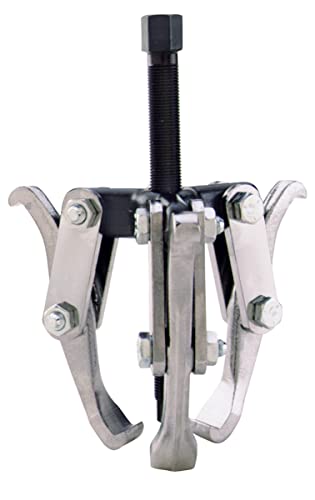
OTC 1026
$165.00 at Amazon
Check it on AmazonPrice as of Nov 16, 2026, 5:34 AM EST · low stock then
Details ↓Four manual jaw pullers scored on their maker’s specs, with a finder for the size your part needs.

As an Amazon Associate I earn from qualifying purchases.
Our top pick is the OTC 1026, a 5-ton puller that sets up with 2 or 3 jaws and spreads to 7 in. Match a puller to your part’s diameter and depth first; the size finder below does that.
All four were new, in stock and sold by Amazon.com at our 12:40 PM check on Oct 26. Each is a manual OTC Grip-O-Matic jaw puller, scored on the same ten checks.


Product prices and availability are accurate as of the date/time indicated and are subject to change. Any price and availability information displayed on Amazon.com at the time of purchase will apply to the purchase of this product.
5-ton Grip-O-Matic puller with 2/3 reversible jaws
Prices and availability are accurate as of the time shown and may change.
Your part is up to 7 in. across and sits within 3‑1/4 in. of its face, and you want the option of three jaws.
The part sits deeper than 3‑1/4 in. The OTC 1036 reaches 8‑3/4 in.
The 1026 is OTC’s 5-ton Grip-O-Matic puller with 2/3 reversible jaws. OTC is a Bosch Automotive Service Solutions brand. It was new and in stock at our 12:40 PM check on Oct 26. It scores 10.0, tied with two other picks; it ranks first on our tie rule because it can run with two or three jaws.
OTC’s page gives the numbers: 5 tons, a 3‑1/4 in. maximum reach and a 7 in. maximum spread. The forcing screw is 9/16 in.-20 by 6‑15/16 in. The upper jaws are 5/16 in. thick and 3/8 in. wide, and the lower jaws, the part that hooks behind the bearing, are 1/4 in. thick and 3/4 in. wide.
Three jaws is the reason to pick it. OTC’s safety guide says that for a better grip and more even pulling power, you should use a 3-jaw puller when possible. The 1026 lets you add the third jaw for that, or drop to two where there isn’t room.
The jaws reverse, which OTC describes on its pages as reversible jaws. Turned outward, they grip inside a bore instead of behind a part, so one tool covers both outside and inside pulls within its reach and spread.
OTC says its pullers are forged from quality steel, heat treated, and subjected to rigorous tests which exceed their rated capacity. That is OTC’s own statement.
The page lists product dimensions of 5.9 by 5.8 by 8.4 in. and a 3.4 lb shipping weight. It links two documents: OTC’s four-page pullers brochure, which promotes a lifetime warranty on its pullers, and OTC’s puller safety guidelines.
Its sibling, the 1024, is the same 5-ton size with two jaws and a 6 in. spread, at 2.05 lb. The 1027 is the long-reach 2/3-jaw version with 5‑1/2 in. of reach, which wasn’t among the Amazon.com-sold listings in our search on Oct 26. Both 1024 and the long 2-jaw 1025 are in our size finder.
Our call: the most flexible size for bearings, pulleys and gears up to 7 in. across. It scores 10.0, a full ten on what OTC publishes.
Prices and availability are accurate as of the time shown and may change.
Your part sits deep, such as a bearing well back on a shaft, and is up to 9‑1/2 in. across.
You want three jaws for an even pull. The OTC 1026 sets up with three.
The 1036 is OTC’s 7-ton long 2-jaw Grip-O-Matic puller. It was new and in stock at our 12:40 PM check on Oct 26. It scores 10.0, tied on points; it ranks second on our tie rule, behind the 2/3-jaw 1026, because it runs with two jaws only.
Reach is its strength. OTC lists an 8‑3/4 in. maximum reach and a 9‑1/2 in. maximum spread. Reach is how far the jaws extend behind the screw’s tip, so a long-reach puller gets behind a part set deep on a shaft.
OTC’s guide still says to keep reach to a minimum: use the shortest legs possible to reach the component. A long puller isn’t the right tool for a part close to the face; that’s where the 5-ton 1026 or 1024 fits.
The forcing screw is 11/16 in.-18 by 9 in. on OTC’s page. OTC’s brochure prints 11/16 in.-19 for the same model. We use the product page and note the difference below. The jaws are 11/32 in. thick and 1 in. wide.
The page lists 11.9 by 7.5 by 2.1 in. and a 5.25 lb shipping weight. It links OTC’s pullers brochure, a pullers family sheet and OTC’s puller safety information. OTC’s page says “Long 2-Jaw” without “reversible”, unlike the shorter 1035 next to it, so we don’t claim inside pulls for the 1036.
The 1035 is the same 7-ton class with a 5 in. reach and a 9 in. spread, reversible jaws and 4.45 lb. The 2/3-jaw versions, the 1037 and 1038, weren’t among the Amazon.com-sold listings in our search. The 1035 is in our size finder.
OTC’s safety rules matter more as the tonnage climbs. Its guide says not to use wrench extensions when applying a load, to apply force gradually and not to use an impact wrench on the forcing screw unless the instructions say so.
Our call: the puller for deep parts up to 9‑1/2 in. across. It scores 10.0, a full ten on OTC’s published facts.
2-ton Grip-O-Matic 2-jaw puller with reversible jaws
Prices and availability are accurate as of the time shown and may change.
You pull small bearings, pulleys or gears up to 4 in. across.
Your part is bigger than 4 in. across. The OTC 1026 spreads to 7 in.
The 1022 is OTC’s 2-ton Grip-O-Matic puller with two reversible jaws. It was new and in stock at our 12:40 PM check on Oct 26. It scores 10.0, tied on points and third on our tie rule because its spread is the smallest.
OTC lists a 3‑1/4 in. maximum reach and a 4 in. maximum spread. The forcing screw is 3/8 in.-24 by 4‑7/8 in. The upper jaws are 3/16 in. thick and 1/4 in. wide; the lower jaws are 1/8 in. thick and 1/2 in. wide, the thinnest here.
Thin lower jaws matter when the gap behind a part is small. A jaw has to slide behind the part before it can pull, so a 1/8 in. jaw fits gaps the 1/4 in. jaws of the 5-ton pullers won’t.
It is the light one. OTC lists product dimensions of 2 by 6.1 by 9.5 in. and a 1.05 lb shipping weight, about a third of the 1026. The jaws reverse for pulling from inside a bore.
Its 3-jaw sibling, the 1023, has the same reach and screw with a 4‑3/4 in. spread and weighs 1.35 lb. It passed the same offer check on Oct 26, and it’s in our size finder. OTC’s advice to use three jaws when possible points toward the 1023 for round parts.
The page links OTC’s pullers brochure, which promotes a lifetime warranty on its pullers, and OTC’s puller safety guidelines. Those guidelines start with eye protection: wear approved safety glasses, goggles or a face shield.
If a small puller won’t move a part, OTC’s guide is plain: if you have applied maximum force and the component hasn’t moved, switch to a larger capacity puller. Don’t add a cheater bar; OTC says not to use wrench extensions when applying a load.
Our call: a light puller for small bearings and pulleys up to 4 in. across. It scores 10.0, a full ten on OTC’s facts.
Prices and availability are accurate as of the time shown and may change.
You pull big parts, up to 15‑1/2 in. across, on trucks, tractors or machinery.
Your part is under 9‑1/2 in. across. The OTC 1036 is less than half the weight.
The 1040 is OTC’s 13-ton long 2-jaw Grip-O-Matic puller. It was new and in stock at our 12:40 PM check on Oct 26. It scores 8.0, the lowest of the four and still over 7.0.
OTC’s page lists 13 tons, a 15‑1/4 in. maximum reach and a forcing screw of 13/16 in.-16 by 12 in. The jaws are 9/16 in. thick and 1 in. wide, much heavier than the 5-ton pullers’ 1/4 in. lower jaws.
The page prints the maximum spread as “15-/12” in., an obvious typo. The Amazon listing says 15‑1/2 in., and we use that in the finder, labeled as the listing’s figure.
It is heavy. OTC gives product dimensions of 18.6 by 3.9 by 3.2 in. and a 13.15 lb shipping weight, more than twelve times the 1022. Plan on supporting it while you set the jaws.
It loses two checks. Unlike the smaller Grip-O-Matic pages, OTC’s 1040 page links no documents: not the pullers brochure with its lifetime warranty message, and not the safety guidelines. The Amazon listing says limited lifetime warranty, but that isn’t OTC’s page.
OTC’s safety guidelines apply to every OTC puller anyway. OTC says to cover the application with a shield or protective blanket before force is applied, to contain flying debris should breakage occur, and not to strike or sledge the puller or component.
OTC also warns that the lowest-capacity component sets the capacity of the whole setup. Its example: a one-ton accessory on a 10-ton puller limits the setup to one ton. Bearing attachments, OTC adds, may not withstand the puller’s full tonnage.
Our call: the puller for large parts on heavy equipment. It scores 8.0, held back by the documents its page doesn’t link.
Measure the part’s outside diameter and how far behind its face the jaws must reach. The finder lists the OTC Grip-O-Matic pullers sold by Amazon.com whose published spread and reach both fit.
Type the part’s diameter and the depth the jaws must reach, in inches.
8 of 10 OTC pullers fit a 5 in. part at 2 in. deep. Smallest capacity first.
Spread is the widest the jaws open, so it has to be at least the part’s diameter. Reach is how far the jaws extend from the cross arm, so it has to cover the depth to where they hook behind the part. The finder compares your numbers with OTC’s and lists every fit, smallest capacity first.
Capacity is the other half. OTC says that if you apply maximum force and the part doesn’t move, switch to a larger capacity puller, and that a puller should be the correct size for the job. The 1040’s spread is the listing’s 15‑1/2 in., since OTC’s page prints a typo.
From OTC’s product pages. Scroll sideways on a phone; tap a header to sort on a computer.
| Puller | Spec score | Tons | Jaws | Reach (in.) | Spread (in.) | Weight (lb) | Buy |
|---|---|---|---|---|---|---|---|
| OTC 1026 | 10.0 | 5 | 2/3-jaw, reversible | 3‑1/4 | 7 | 3.4 | Check it on Amazon |
| OTC 1036 | 10.0 | 7 | long 2-jaw | 8‑3/4 | 9‑1/2 | 5.25 | Check it on Amazon |
| OTC 1022 | 10.0 | 2 | 2-jaw, reversible | 3‑1/4 | 4 | 1.05 | Check it on Amazon |
| OTC 1040 | 8.0 | 13 | long 2-jaw | 15‑1/4 | 15‑1/2 | 13.15 | Check it on Amazon |
Why only OTC: of the manual jaw pullers sold by Amazon.com on Oct 26, OTC was the maker whose pages publish the forcing screw, jaw sizes, weight and linked safety and warranty documents for each model. Sunex, GEARWRENCH and Posi Lock are in the left-out table.
These two numbers decide whether a puller fits the part at all.
The long models trade spread for reach. The 5-ton 1024 and long 1025 both spread to 6 in., but the 1025 reaches 5‑1/2 in. against 3‑1/4 in. OTC’s guide still says to use the shortest legs that reach the part, so pick the shortest reach that covers your depth.
OTC also says not to couple puller legs: capacity drops when longer-than-standard legs are used or when legs are compressed, and the chance of breakage goes up.
OTC’s safety guide says to use a 3-jaw puller when possible, for a better grip and more even pulling power.
| Setup | OTC models here | What it does |
|---|---|---|
| 2-jaw | 1022, 1024, 1025, 1035, 1036, 1039, 1040 | Fits where there’s room for only two jaws |
| 2/3-jaw | 1023, 1026, 1042 | Add a third jaw for a more even pull, per OTC’s guide |
| Reversible jaws | 1022, 1023, 1024, 1025, 1026, 1035 | Jaws turn to grip inside a bore |
| Puller | Jaw thickness | Jaw width |
|---|---|---|
| OTC 1022 | 3/16 in. upper, 1/8 in. lower | 1/4 in. upper, 1/2 in. lower |
| OTC 1023 | 3/16 in. upper, 1/8 in. lower | 1/4 in. upper, 1/2 in. lower |
| OTC 1024 | 5/16 in. upper, 1/4 in. lower | 3/8 in. upper, 3/4 in. lower |
| OTC 1025 | 5/16 in. upper, 1/4 in. lower | 3/8 in. upper, 3/4 in. lower |
| OTC 1026 | 5/16 in. upper, 1/4 in. lower | 3/8 in. upper, 3/4 in. lower |
| OTC 1035 | 5/16 in. upper, 11/32 in. lower | 1 in. upper, 1 in. lower |
| OTC 1036 | 11/32 in. | 1 in. |
| OTC 1039 | 9/16 in. | 1 in. |
| OTC 1040 | 9/16 in. | 1 in. |
| OTC 1042 | 9/16 in. | 1 in. |
Thickness is what has to fit behind the part. The 2-ton 1022 and 1023 have 1/8 in. lower jaws; the 13-ton pullers use 9/16 in. jaws. When a jaw won’t fit behind a bearing, OTC’s brochure points to bearing splitters such as the 1123, whose knife-like edges seat behind components, for use with a push-puller or Grip-O-Matic pullers.
The forcing screw is the center bolt you turn. OTC publishes its size for every model.
| Puller | Tons | Forcing screw |
|---|---|---|
| OTC 1022 | 2 | 3/8 in.-24 × 4‑7/8 in. |
| OTC 1023 | 2 | 3/8 in.-24 × 4‑7/8 in. |
| OTC 1024 | 5 | 9/16 in.-20 × 6‑15/16 in. |
| OTC 1025 | 5 | 9/16 in.-20 × 6‑15/16 in. |
| OTC 1026 | 5 | 9/16 in.-20 × 6‑15/16 in. |
| OTC 1035 | 7 | 11/16 in.-18 × 9 in. |
| OTC 1036 | 7 | 11/16 in.-18 × 9 in. |
| OTC 1039 | 13 | 13/16 in.-16 × 12 in. |
| OTC 1040 | 13 | 13/16 in.-16 × 12 in. |
| OTC 1042 | 13 | 13/16 in.-16 × 12 in. |
OTC’s maintenance advice is short: keep the puller clean and lubricate the forcing screw often, from threads to tip. Its guide also says to inspect the forcing screw for signs of galling or seizing before use, and to replace worn or damaged parts.
From OTC’s puller safety guidelines (form 566109 Rev. B). OTC: “A pulling system can exert tons of force and it is difficult to predict the exact force required.”
| Rule (OTC) |
|---|
| Wear approved eye protection, such as safety glasses, goggles or a face shield. |
| Inspect the puller for dents, cracks or excessive wear before use; check the forcing screw for galling or seizing. |
| Do not exceed the puller’s rated capacity, spread or reach. |
| Align the puller and seat it on the part; jaws must be parallel to the forcing screw. |
| Do not use wrench extensions when applying a load. |
| Cover the application with a shield or protective blanket before force is applied, to contain flying debris should breakage occur. |
| Apply force gradually; don’t use an impact wrench on the forcing screw unless instructions say so. |
| Do not strike or “sledge” the puller or component. |
| Do not modify the puller by grinding, heating or other means. |
| The lowest-capacity component sets the capacity of the whole setup. |
These are OTC’s rules, quoted or summarized; we add none of our own. OTC’s guide also says to tighten the adjusting strap bolts on a jaw-type puller so the grip is tight, and to check that the setup is rigid and square before you apply force.
We score the warranty only when a document linked from the model’s own page states it.
| Models | Maker document linked | What it says | Listing |
|---|---|---|---|
| 1022 to 1026, 1035, 1036 | OTC pullers brochure | Trusted pullers with a lifetime warranty | Limited lifetime or lifetime |
| 1039, 1040, 1042 | None linked | — | Lifetime or limited lifetime |
OTC’s brochure leads with “Trusted pullers with a lifetime warranty”. The 13-ton pages don’t link it, so they score 0 on that check, even though their listings say lifetime. Several listings add that the warranty doesn’t cover abuse.
All sold by Amazon.com, new and in stock on Oct 26.
| Puller checked | Status | Why it isn’t a pick |
|---|---|---|
| Sunex 3908 5-ton 2/3-jaw | 5.0 | Sunex’s page lists reach, spread and jaws but no screw, jaw size, weight, warranty or safety document |
| GEARWRENCH 3551D 2-ton 2-jaw | Before scoring | GEARWRENCH’s site search didn’t return a 3551D page to score against |
| Posi Lock 113 30-ton 3-jaw | Before scoring | A 30-ton shop puller, a different class from these hand pullers |
| Other OTC sizes (1023, 1024, 1025, 1035, 1039, 1042) | In the size finder | Same line, scored the same; listed by size |
| Hydraulic pullers, slide hammers, bar-type pullers | Before scoring | Different kinds of puller |
The other OTC sizes score the same as their siblings: 10.0 for the 1023, 1024, 1025 and 1035, and 8.0 for the 1039 and 1042, whose pages also link no documents. They’re in the finder so you can match the exact size.
Where OTC’s pages, its brochure and the Amazon listings differ.
| Topic | One source | Another | We use |
|---|---|---|---|
| OTC 1040 spread | OTC page: “15-/12” in. | Listing: 15‑1/2 in. | 15‑1/2 in., labeled as the listing’s |
| OTC 1036 screw thread | OTC page: 11/16 in.-18 × 9 in. | OTC brochure: 11/16 in.-19 × 9 in. | The product page |
| OTC 1027 spec line | Brochure: “7 in. max reach for 1027” | Brochure heading: 5‑1/2 in. max reach | Not a pick; noted |
We searched the CPSC recall list on Oct 26, 2026.
| Search | Recalls found |
|---|---|
| Puller, gear puller, jaw puller | None |
| OTC | None for OTC tools |
| Bearing puller | CPSC’s search returned an error three times; the broader searches above cover it |
Answer these in order. Each answer narrows the picks.
| Question | If yes | If no |
|---|---|---|
| Is the part 4 in. across or less, within 3‑1/4 in. of the face? | OTC 1022 (or the 3-jaw 1023) | Next question |
| Up to 7 in. across, within 3‑1/4 in.? | OTC 1026 | Next question |
| Up to 9‑1/2 in. across, set deep (up to 8‑3/4 in.)? | OTC 1036 | Next question |
| Bigger, on heavy equipment? | OTC 1040 (up to 15‑1/2 in.) | Use the size finder |
| Is the gap behind the part too small for a jaw? | Look at a bearing splitter | A jaw puller works |
Fit comes first: diameter, then depth, then capacity. Then think about jaws: OTC prefers three where they fit. If the job is on a car, our mechanic tool set guide covers the sockets and wrenches you’ll turn the screw with, and a floor jack with jack stands gets you under it safely.
Our top pick is the OTC 1026, which scores 10.0: a 5-ton Grip-O-Matic puller that sets up with 2 or 3 jaws and spreads to 7 in. The best puller for you is one whose spread and reach fit your part.
OTC sells these as Grip-O-Matic pullers for removing and installing parts, and its brochure files them next to its gear and pulley pullers. When the jaws can’t get behind a bearing, a bearing splitter clamps behind it and works with a puller.
OTC’s safety guide says to use a 3-jaw puller when possible for a better grip and more even pulling power. A 2-jaw puller fits where there isn’t room for three.
Spread is how wide the jaws open, which has to be at least the part’s diameter. Reach is how far the jaws extend, which has to cover the depth to where they grip. Our size finder checks both.
Measure the part’s diameter and depth and use our size finder. OTC says to use the correct size and, if maximum force doesn’t move the part, to switch to a larger capacity puller.
OTC says not to use an impact wrench to apply force unless the instructions specify it, and to apply force gradually.
OTC says do not strike or “sledge” the puller or the component.
OTC says to wear approved eye protection, such as safety glasses, goggles or a face shield, and to cover the job with a shield or protective blanket before force is applied.
OTC’s pullers brochure leads with a lifetime warranty, and it’s linked from the 2- to 7-ton pages. The 13-ton pages don’t link it; their Amazon listings say lifetime.
OTC says to keep it clean and lubricate the forcing screw often, from threads to tip, and to inspect it for dents, cracks, wear and a galled or seized screw before each use.
Prices change, so each card shows today’s Amazon price with the time we read it. Our scores don’t use price.
We looked at one kind of product: manual jaw pullers with a forcing screw. Every listing passed an offer read on Amazon at 12:40 PM on Oct 26, 2026: new, in stock, sold by Amazon.com and the buy-box winner. We matched each to OTC’s page by model number.
Ten checks, one point each, make the score out of 10. A fact the maker doesn’t publish scores 0, and documents count only when the model’s page links them. Ties go to more jaw setups, then larger spread.
Isaac Daniels, who owns Plain Buy Guides, edits this page. We read OTC’s product pages for ten Grip-O-Matic pullers, OTC’s pullers brochure and puller safety guidelines, Sunex’s 3908 page and the CPSC recall list, all on Oct 26, 2026.
The ten checks, part one: the maker publishes the capacity; the maximum reach; the maximum spread; the forcing screw size; and the jaw thickness and width.
Part two: the jaw setup; the product size or weight; a warranty term in a document the model’s page links; a safety guide the page links; and a SKU that matches the Amazon listing.
| Puller | Capacity | Max reach | Max spread | Forcing screw | Jaw size | Jaw setup | Size and weight | Maker warranty | Safety guide | Listing match | Score |
|---|---|---|---|---|---|---|---|---|---|---|---|
| OTC 1026 | 1 | 1 | 1 | 1 | 1 | 1 | 1 | 1 | 1 | 1 | 10.0 |
| OTC 1036 | 1 | 1 | 1 | 1 | 1 | 1 | 1 | 1 | 1 | 1 | 10.0 |
| OTC 1022 | 1 | 1 | 1 | 1 | 1 | 1 | 1 | 1 | 1 | 1 | 10.0 |
| OTC 1040 | 1 | 1 | 1 | 1 | 1 | 1 | 1 | 0 | 0 | 1 | 8.0 |
| Sunex 3908 | 1 | 1 | 1 | 0 | 0 | 1 | 0 | 0 | 0 | 1 | 5.0 |